Wednesday, November 11, 2009

The 2009 Glamour Women of the Year award show

The 2009 Glamour Women of the Year award show

Musician Rihanna arrives for the 2009 Glamour Women of the Year award show in New York November 9, 2009.[Agencies]


The 2009 Glamour Women of the Year award show

California's first lady Maria Shriver arrives for the 2009 Glamour Women of the Year award show in New York November 9, 2009.[Agencies]


The 2009 Glamour Women of the Year award show

Model Iman arrives for the 2009 Glamour Women of the Year award show in New York November 9, 2009.[Agencies]


The 2009 Glamour Women of the Year award show

Serena Williams arrives for the 2009 Glamour Women of the Year award show in New York November 9, 2009.[Agencies]


The 2009 Glamour Women of the Year award show

Musician Rihanna accepts a 2009 Glamour Women of the Year award during the magazines annual award show in New York November 9, 2009.[Agencies]


The 2009 Glamour Women of the Year award show

Musician Rihanna accepts a 2009 Glamour Women of the Year award during the magazines annual award show in New York November 9, 2009.[Agencies]


The 2009 Glamour Women of the Year award show

Musician Rihanna arrives for the 2009 Glamour Women of the Year award show in New York November 9, 2009.[Agencies]


The 2009 Glamour Women of the Year award show

Musician Rihanna arrives for the 2009 Glamour Women of the Year award show in New York November 9, 2009.[Agencies]


taken from : China Daily


Read more!

Madonna to model for Dolce & Gabbana

Madonna to model for Dolce & Gabbana

Madonna is to front Dolce & Gabbana's spring/summer 2010 campaign, reports People.

The 51-year-old popstar has moved on from modelling for Louis Vuitton in order to work for the popular Italian fashion duo, D&G announced in its online magazine Swide.

"To have Madonna in our campaign is a dream come true," Domenico Dolce and Stefano Gabbana said.

D&G designed the costumes for the singer's 1993 'The Girlie Show' tour and last year's 'Sticky & Sweet' jaunt.

Photographer Steven Klein reportedly shot Madonna's first ads for the label last week in New York.


taken from : China Daily


Read more!

Tuesday, November 10, 2009

Penelope Cruz attends at her latest movie "Broken Embraces" in Rome

Penelope Cruz attends at her latest movie

Spanish actress Penelope Cruz (L) and director Pedro Almodovar pose for photographers as they promote their latest movie "Broken Embraces" in Rome November 7, 2009. [Agencies]


Penelope Cruz attends at her latest movie

Spanish actress Penelope Cruz (L) and director Pedro Almodovar pose for photographers in front of the Trevi Fountain as they promote their latest movie "Broken Embraces" in Rome November 7, 2009. [Agencies]


Penelope Cruz attends at her latest movie

Spanish actress Penelope Cruz (R) and director Pedro Almodovar pose for photographers as they promote their latest movie "Broken Embraces" in Rome November 7, 2009. [Agencies]


Penelope Cruz attends at her latest movie

Spanish actress Penelope Cruz (L) and director Pedro Almodovar promote their latest movie "Broken Embraces" in Rome November 7, 2009. [Agencies]


Penelope Cruz attends at her latest movie

Spanish actress Penelope Cruz (L) and director Pedro Almodovar pose for photographers in front of the Trevi Fountain as they promote their latest movie "Broken Embraces" in Rome November 7, 2009. [Agencies]


Penelope Cruz attends at her latest movie

Spanish actress Penelope Cruz (L) and director Pedro Almodovar pose for photographers in front of the Trevi Fountain as they promote their latest movie "Broken Embraces" in Rome November 7, 2009. [Agencies]


Penelope Cruz attends at her latest movie

Spanish actress Penelope Cruz poses for photographers in front of the Trevi Fountain as she promotes her latest movie "Broken Embraces" in Rome November 7, 2009. [Agencies]


taken from : China Daily


Read more!

The highs and lows of life as China's top foreign model

The highs and lows of life as China's top foreign model

Anina Trepte walks a show for designer Frankie Xie.

No one wanted Anina Trepte to come to China. The agents and designers she was working for in Paris told her it would ruin her career. There was no fashion here, no modeling industry, no chance for her to rise to the top or make any money, they said.

She came anyway.

"I always have just done whatever I wanted to do at any cost, at any price," Trepte said.

"Life gives you signs, and if you know how to read those signs, you will end up at the right place at the right time."

It was around 3 pm on Saturday, nearing the end of the annual China Fashion Week, and Trepte was sitting in the corner of a dressing room in the Grand Hyatt Beijing preparing to walk in the show of Frankie Xie, the designer behind Jefen, the first Chinese brand to emerge onto the global haute couture stage.

"He is one of the most professional designers in China," Trepte, who was wearing her signature red jacket over a pair of skinny black jeans, said. "He does fittings like they do in Paris."

Why exactly Trepte decided to flee the runways of Paris for the catwalks of China is a question better answered by her appearance than with words.

The 20-something model's blazing red hair, penetrating blue eyes and rose-colored skin are an anomaly in a fashion industry, that, while is gradually becoming more globalized, still has only a handful of models who are not Chinese.

"If you have a unique look, you can get chosen for a lot of things," Trepte said. "I am the only red-haired model, at least in Beijing. If designers want that classic Ralph Lauren look, I get the job."

Since Trepte landed in China two years ago, she has collaborated with a number of designers from the country's top labels, including Jefen, White Collar and Occi Vivi, as well as leading photographers and fashion studios.

The highs and lows of life as China's top foreign model

And in Beijing, she has become something of a celebrity, frequenting local radio and television programs, hosting high-profile events and attending the city's most posh parties. CCTV recently awarded her with the title of China's top foreign model.

"To become the top, you have to make people love you," Trepte said. "You have to have this inner power. It is something inside. Not a lot of people know that."

And there is also a side to living life as a foreign model in China that most will never know.

Underneath the glamorous clothes and makeup, there is loneliness, especially for models like Trepte, who do not speak Chinese or Russian, the nationality of many of the other women who work on the runways.

"Sometimes I feel very small here. Some days I think I should leave here. It is too difficult," she said. "There have been foreign models whose agents promised them they would make a lot of money. They never did."

After the Jefen show ended, Trepte changed back into her red jacket and skinny jeans and walked alone to a casting down the street at the Beijing Hotel where she waited with dozens of women to strut for a few moments in front of a panel of designers picking models for another show.

"How was my walk?" she asked after the audition. "Did I look like I was slouching?"

Trepte does not like to reminisce about her past. "I hate the past because it dates you," she said. "I prefer to talk about the future."

"Now, thanks to China, I have the shots I need to get jobs in America," Trepte said. "I can finally become one of those high earning models. There is nothing to stop me."

Trepte, however, does worry about her future. What will happen if she does not become a fashion icon?

"Will I have to work in a restaurant?" she said.

Her backup plan is a project called 360Fashion, a network of fashion professionals who collaborate using Web 2.0 and mobile technologies that Trepte launched at the 2005 Paris Fashion Show.

Trepte is now trying to widen the community to include China.

In her spare time, she visits clothing factories, fashion designers, photographers and studios around the country, working to build a bridge between clothing design in the East and West.

"China was the logical next step to complete the circle," she said. "If there was no China, there would be no fashion."

Trepte, also known as Anina.net, has launched her own fashion mobile gaming application in China and the US and is working on prototypes of a mobile fashion magazine.

She is always connected, using her mobile phone to blog about the fashion industry in China and abroad with the goal of making a traditionally closed sector more open to the public.

"I want to be this new type of model," said Trepte, a regular at tech conferences around Beijing. "I want to be a social media model and open the door to the fashion industry."

At her apartment, hours after the fashion show and casting, Trepte grabbed a handful of popcorn, put on a coat of bright red lipstick and grabbed her red jacket to head out to a party for the evening.

As she picked up her purse, she stopped for a moment at the door and asked: "I have made my mark?"


taken from : China Daily


Read more!

South Korean star Rain smiles during news conference for his new movie 'Ninja Assassin'

South Korean star Rain smiles during news conference for his new movie 'Ninja Assassin'

South Korean singer and actor Rain smiles during a news conference for his new movie "Ninja Assassin" at a hotel in Seoul November 9, 2009. [Agencies]


South Korean star Rain smiles during news conference for his new movie 'Ninja Assassin'

South Korean singer and actor Rain poses for photographs during a news conference for his new movie "Ninja Assassin" at a hotel in Seoul November 9, 2009. [Agencies]


South Korean star Rain smiles during news conference for his new movie 'Ninja Assassin'

South Korean singer and actor Rain speaks to the media in front of a poster of his new movie "Ninja Assassin" during a news conference at a hotel in Seoul November 9, 2009. [Agencies]


taken from : China Daily


Read more!

Monday, November 9, 2009

A fight to the death

A fight to the death

Ten years after he first exposed China's "AIDS villages", Dr Gui Xi'en, 72, continues to visit rural communities in Henan, offering treatment and counseling to those affected.

A noisy cab speeds along a dark country road on a muggy Friday night in July. Dr Gui Xi'en, 72, sits on the cramped back seat with a satchel on his shoulder and suitcase on his lap.

He is on his way to Shangcai, an AIDS-ravaged county in central China's Henan province.

As the cab approaches the county seat, Gui directs it to a small hotel. He plans to stay the night and quietly visit the villages the next day.

Ten years after he first exposed their deadly secret in 1999, Gui who blew the whistle on China's "AIDS villages" is still sneaking into rural communities in Shangcai, offering counseling to those dying from the epidemic.

"I came secretly before, because they (local officials) were not nice to me. I still come secretly now, because they are too nice to me," says Gui.

"If they know I am here, they will come see me and invite me for lunch or dinner. I think that is unnecessary and I don't like it."

From being driven out of the villages to being treated as an "important guest", Gui's experiences reflect China's changing official attitude toward the HIV/AIDS plague, believed to be the most serious public health problem confronting new China since 1949.

An infectious diseases specialist with Zhongnan Hospital at Wuhan University in neighboring Hubei province, Gui first visited Wenlou, a village of Shangcai in July 1999 as a favor to a fellow doctor there.

A fight to the death

HIV/AIDS was the last thing he expected to find. Some villagers suffered from constant fever and diarrhea. People died every month, with their bodies covered in sores and dark, wine-colored blotches. Panic had seized the village.

Gui took 11 blood samples from the villagers, and found 10 to be HIV positive. He immediately informed the local health authorities and urged them to take action. But their response was to refuse him further entry to the villages.

Two months later, during a long-weekend holiday when he calculated that officials would let their guard down, he sneaked back into Wenlou with three students. After three days of house calls, Gui returned to Wuhan with 159 blood samples. The result was shocking - 90 of them were HIV positive.

Gui realized that he had stumbled on a full-blown AIDS epidemic, something he had only read about in medical journals.

The origins of the tragedy went back to an unchecked blood selling and collecting industry that flourished in the early 1990s.

Armed with detailed data and analysis, Gui wrote a letter to Beijing. With the central government involved, the local authorities could no longer hide the lethal infection. But they looked on Gui even more unfavorably.

On June 8, 2001, Gui went to Wenlou alone. He took medicines for the villagers. The county government sent police to expel him. Gui escaped with the help of villagers, who hid him from the police, and moved him to a safer place by motorcycle in the middle of the night.

The mild-mannered doctor then wrote to the county authorities in an uncharacteristically strong tone: "One day the tragedy will be written into history and those responsible will be condemned by history."

Today, the health clinics Gui visits in the AIDS villages provide free HIV testing and antiretroviral treatments, and charity homes shelter AIDS orphans and the elderly, whose caretakers have died of AIDS.

Nationwide, the government has been providing free antiretroviral treatments to rural HIV/AIDS patients since 2004, and to urban sufferers facing financial difficulties. The government has also provided free HIV screening, free therapy to block mother-to-infant transmission, free infant HIV testing and financial assistance for children who have lost their parents to the epidemic.

This summer, Premier Wen Jiabao visited Gui at his home, and thanked him for his efforts in checking the epidemic. In 2007 and again in 2008, Wen invited Gui to join him on visits to HIV/AIDS villages and AIDS orphans.

The Chinese media hailed Gui as a medical hero, but Gui is far more comfortable talking about the villagers than about his role in revealing the epidemic. He says, "I just did what a doctor should do."

On this Saturday morning, when Gui arrives at bus stop outside Houyang village, Zhao Qiang (not his real name), a farmer with HIV, is already there waiting for him.

"Dr Gui is honest, kind and gentle, and is always ready to help. Whenever we call and ask him to come to the village, he comes," says Zhao, whose wife and 6-year-old son are also infected with HIV.

After picking him up, Zhao takes Gui by his motor-pedicab directly to his home, where HIV carriers and AIDS patients are waiting.


A fight to the death

This 2001 file photo shows Dr Gui Xi'en with AIDS patients from Henan in his home in Wuhan, in neighboring Hubei. The five were put up in an abandoned building pending further checks, but were booted out by the neighbors.

"I cannot take him to the village clinic. There would be too many people there to see him. He might not be able to leave today."

As Gui sees his patients at Zhao's dilapidated house, Cheng Dong (not his real name) waits anxiously at the Shangcai County Hospital. Cheng's cousin with AIDS is in hospital. Cheng calls Gui and asks him to come. He also wants Gui's help in getting his daughter enrolled in a good local high school.

Cheng sees nothing inappropriate in his requests. He is sure Gui will help. He was among the first 10 HIV-positive villagers Gui diagnosed 10 yeas ago, and Gui has continued to extend medical and financial help ever since.

"He is a marvelous man," Cheng says. "He was unpopular here in the past. Since Premier Wen visited him, everything has changed. But he has not changed. He is still the Dr Gui I know."

Despite his age, Gui works full time and spends most weekends and holidays visiting poor farmers, a routine he formed almost 50 years ago.

In 1960, the then medical graduate of 23, volunteered to work in the remote hinterlands of Qinghai province on the Qinghai-Tibet Plateau, answering the government's call for young intellectuals to work and settle in the frontier areas.

During his 16 years in Qinghai, he focused on curbing infectious diseases and endemics, such as measles, typhoid and plague. But as medical staff were scarce, he was surgeon, laboratory analyst, anesthetist and pharmacist.

He once amputated the seriously injured arm of a herdsman. "The man said I saved his life and was grateful to me. But I felt sorry for him, because a proficient surgeon with good facilities might have been able to save his arm."

Gui recalls visiting and treating the herders' families. "I didn't need Tibetan translators at that time because I spent so much time with them that I could speak Tibetan fairly well."

The bleak and wild plateau also served as a refuge for Gui from the turbulence of the "cultural revolution" (1966-76).

Gui was born to well-educated parents, both US-trained scholars. His father graduated from Princeton University with a doctorate in physics. His half-Chinese, half-Dutch mother graduated from Columbia University. They returned to China in the 1920s.

During the "cultural revolution", many Chinese with "complicated family backgrounds" or relatives overseas suffered persecution.

Despite his "problematic" genealogy, he could still go to villages and the pastoral regions and offer medical help to herdsmen. "I was on good terms with the locals, so I didn't suffer much," he says.

The experience taught Gui that doctors had to work in their communities, rather than wait in clinics for patients, a lesson he passes on to his students.

"Infectious diseases are not only medical problems, but also social problems. We must reach out to the people in need."

The same afternoon, Gui meets Cheng Dong and his cousin in Shangcai County Hospital. He reads the girl's medical records and offers advice to the resident physicians. He also discusses with Cheng his daughter's schooling.

As he is about to leave, a girl approaches him. "Dr Gui, could you please have a look at my mother? She doesn't feel well and has not eaten much for a week," she pleads. Without hesitation, Gui follows the girl to her mother's ward.

At about 4 pm, Gui has to leave for Zhumadian city to catch a train back to Wuhan. He apologizes to the families of patients who are still waiting to see him and promises to return.

On the bus to Zhumadian, he looks drawn. "Once I was able to see about 30 to 40 patients on a day like this," he says. "I am really inefficient now."

It is a comment that belies his strong sense of urgency. He describes himself as an "old farm ox", aware that its life is almost at an end but nevertheless plows on diligently.

He quietly recalls a colleague, a year his senior, who died suddenly a week ago, while eating at a restaurant. Gui attended the funeral the day before he left for Shangcai.

"His family was heartbroken at his sudden death. But I admire him. I think this is a good way to leave, without suffering much and burdening other people," he says.

"For people my age, this (death) is a natural thing," he says with a slight smile. "That's why I hope I can still do something. I may not have much time left."


taken from : China Daily


Read more!

Colin Farrell at Sevilla European film festival

Colin Farrell at Sevilla European film festival

Irish actor Colin Farrell poses during Sevilla European film festival in the Andalusian capital of Seville November 6, 2009. The festival will run from November 6 to 14. [Agencies]


Colin Farrell at Sevilla European film festival

Irish actor Colin Farrell (R) and Spanish actress Paz Vega pose during Sevilla European film festival in the Andalusian capital of Seville November 6, 2009. The festival will run from November 6 to 14. [Agencies]


Colin Farrell at Sevilla European film festival

Irish actor Colin Farrell, Spanish actress Paz Vega and British actor Christopher Lee (R-L) pose during Sevilla European film festival in the Andalusian capital of Seville November 6, 2009. The festival will run from November 6 to 14.


Colin Farrell at Sevilla European film festival

Irish actor Colin Farrell poses during Sevilla European film festival in the Andalusian capital of Seville November 6, 2009. The festival will run from November 6 to 14. [Agencies]


Colin Farrell at Sevilla European film festival

Irish actor Colin Farrell (R), Spanish actress Paz Vega and British actor Christopher Lee (L) pose during the Sevilla European film festival in the Andalusian capital of Seville November 6, 2009. The festival will run from November 6 to 14. [Agencies]


Colin Farrell at Sevilla European film festival

Irish actor Colin Farrell, Spanish actress Paz Vega and British actor Christopher Lee (R-L) pose during Sevilla European film festival in the Andalusian capital of Seville November 6, 2009. The festival will run from November 6 to 14. [Agencies]


taken from : China Daily


Read more!

Fashion house Ferragamo's museum goes online

Fashion house Ferragamo's museum goes online

A model presents a creation as part of Salvatore Ferragamo Spring/Summer 2010 women's collection during Milan Fashion week September 27, 2009.[Agencies]

MILAN –Italian fashion house Salvatore Ferragamo has taken a museum detailing its history and culture online, allowing young designers to add their creative touch to its shoe models.

The website, www.museoferragamo.com, is dedicated to its "shoemaker to the stars" founder and includes pictures, vintage films relating to the Florence-based maison, which is known for its shoes, silk ties and scarves as well as handbags.

The fashion house, for whom Claudia Schiffer has modeled, was founded in the 1920s by the late Salvatore Ferragamo who started out designing footwear and made shoes for the likes of Marilyn Monroe, Greta Garbo and Audrey Hepburn.

Visitors can browse through Ferragamo archives as well as book tickets to the actual museum in Florence. Artists can download famous shoe models, redesign them and send them back with a panel of judges picking a winner to join a virtual gallery every three months.


taken from : China Daily


Read more!

Menswear out of the closet

Menswear out of the closet

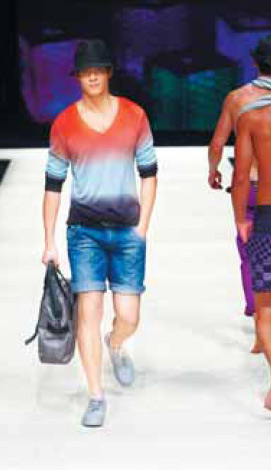
Menswear design has always been weaker than for women, but China Fashion Week 2009 was determined to correct this. Six menswear fashion shows were held, though most were criticized as "too feminine" by Chinese media.

Fujian-based men's fashion brand Cabbeen opened China Fashion Week to show off its T-shirts, semi-formal shorts and tight pants. Scarves were in bright colors: milk-yellow, pink, and light blue.

Designer Yang Ziming added women's belts, large-sized handbags and tassels in the collection, for a hippie-look.

Yang said his ideas mostly originated from modern architecture.

"There are many buildings with windows in cities, so you can see pearl-like or glass-like materials in my costumes," Yang says.

VLOV menswear, designed by Wu Qingqing, frequently used hemp material for an eco-friendly look. Colors were black, white and blue, while the deep V-shaped collars, thin belts and gloves were feminine in inspiration.

"Men usually have two faces. Sometimes they can be manly, but other times they have to be careful, detailed, and patient," Wu explains.

ZUOAN Hong Jinshan menswear show was more masculine. Inspired by retro-futurism, designer Hong Jinshan used silver, shining blue and light brown to create a "future world".

Most of the costumes were uniform-like. A black pilot jacket, with vintage sunglasses, was reminiscent of Tom Cruise in Top Gun. Converse-like sneakers showed up with a long jacket, for a mix-match style.

Mihuang Qi Gang designer Qi Gang showed off his cashmere creations himself. An oversized red scarf was tied under his shoulders, a black-and-white T-shirt went with a pair of tight leggings, and the ankle-high black boots were feminine-looking.

Qi's personal show, one-day later, was wild. Animal patterns were the most obvious elements, with feathers, grassland-green skirts, and zebra-striped trousers.

Male models for luxury brand Ne Tiger's show wore oversized fur scarves with a dark blue gown, for an ancient scholarly image. There was an all-white Western suit, but the buttons were shaped like fans. Yang Jian, secretary general of China Fashion Week Committee, said this year there would be more male fashion.

"It is because their tastes are developing and there is a market here."

Ao Yanmin, general manager of Rich Public Relation Company, was involved in most menswear shows during fashion week.

She said there were more male brands, but disagreed with the idea they were more feminine. "It is an international trend that clothing is taking on 'bi-gender' characteristics. Menswear is more feminine, and women's wear is more manly."


taken from : China Daily


Read more!

Pakistan models defy Taliban with 1st fashion week

Pakistan models defy Taliban with 1st fashion week

A model takes to the catwalk with a creation by Pakistani designer Zahid Khan labeled Kuki Concepts during Fashion Pakistan Week in Karachi November 7, 2009.[Agencies]

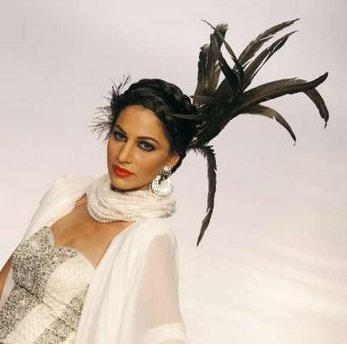
KARACHI, Pakistan – Some women strode the catwalk in vicious spiked bracelets and body armor. Others had their heads covered, burqa-style, but with shoulders — and tattoos — exposed. Male models wore long, Islamic robes as well as shorts and sequined T-shirts.

As surging militant violence grabs headlines around the world, Pakistan's top designers and models are taking part in the country's first-ever fashion week. While the mix of couture and ready-to-wear fashions would not have been out of place in Milan or New York, many designers made reference to the turmoil, reflecting the contradictions and tensions coursing through this society.

The four-day event, which was postponed twice due to security fears and amid unease at hosting such a gathering during an army offensive in the northwest, is aimed at showing the world there is more to Pakistan than violence and at helping boost an industry that employs hundreds of thousands of people, organizers said.

Many of the models, designers and well-heeled fashionistas packing out each night said the gathering was a symbolic blow to the Taliban and their vision of society, where women are largely confined to the house and must wear a sack-like covering known as a burqa.

"This is our gesture of defiance to the Taliban," said Ayesha Tammy Haq, the CEO of Fashion Pakistan Week. "There is a terrible problem of militancy and political upheaval ... but that doesn't mean that the country shuts down. That doesn't mean that business comes to a halt."

The shows are taking place in Karachi, the country's largest and most cosmopolitan city, in a five-star hotel just next door to the American consulate, which was bombed by Islamist militants in 2002. It's two hours by plane from the northwest, the heartland of al-Qaida and the Taliban, and has largely been spared the violence sweeping the country over the last month.

"Unfortunately, it is the bad side of Pakistan that gets everybody's attention," said top Pakistani model Nadia Hussain as hairdressers and makeup artists fussed over her backstage. "It has never been this bad, I don't know what will happen," she said, as fellow models chain-smoked cigarettes.

While many of the city's 12 million people live in slums, hip cafes and restaurants in wealthy neighborhoods draw sophisticated crowds of young men and women into the early hours, more often than not speaking English with each other and wearing Western dress.

While the shows in Karachi resembled fashion weeks in other parts of the world, there were no foreign designers or buyers. The organizers decided not to invite them given the precarious security situation.

"Who is going to come here with such negative stuff going on?" said Tabassum Mughal, a young designer who employs about 30 people. "Those who are here already are leaving."

Textiles make up some 60 percent of Pakistan exports and are worth around $12 billion dollars a year. The country's cotton and silks are among the finest in the world. But the industry has failed to grow in recent years amid political unrest, violence and chronic power shortages.

As if on cue, a power cut during the fashion week's opening evening left the hall in darkness for several minutes.

The fashion industry represents a tiny fraction of the country's textile exports.

"We are still doing the 30 dollar a dozen T-shirt business. There is no value added," said Haq. "We should be employing millions of people, not hundreds of thousands of them."

Designers presented a mix of clothes, some drawing on traditional Pakistani outfits and tribal motifs, others that had little or no sign of traditional aesthetics. In a culture where nearly all women dress modestly, many outfits were too racy for local tastes.

"This does not represent what we are as a people," designer Ayesha Tahir Masood said. "Only 0.001 percent of Pakistani women would wear these clothes, and then only in a controlled environment when drunk out of their minds."


taken from : China Daily


Read more!

Friday, November 6, 2009

Top-earning celebrities this year according to Forbes

Top-earning celebrities this year according to Forbes

1: Talk show host Oprah Winfrey was the highest-earning celebrity this year with an estimated income of $275 million according to Forbes.[Agencies]


Top-earning celebrities this year according to Forbes

2: George Lucas came second with estimated earnings of $170 million.[Agencies]


Top-earning celebrities this year according to Forbes

3: Steven Spielberg is third with $150 million.[Agencies]


Top-earning celebrities this year according to Forbes

4: Madonna took home $110 million this year.[Agencies]


Top-earning celebrities this year according to Forbes

4: As did Tiger Woods.[Agencies]


Top-earning celebrities this year according to Forbes

6: Jerry Bruckheimer is sixth with $100 million.[Agencies]


Top-earning celebrities this year according to Forbes

7: Beyonce is seventh with $87 million.[Agencies]


Top-earning celebrities this year according to Forbes

8: Jerry Seinfeld is eighth with $85 million.[Agencies]


Top-earning celebrities this year according to Forbes

9: Dr. Phil McGraw is ninth with $80 million.[Agencies]


Top-earning celebrities this year according to Forbes

10: Simon Cowell is tenth with $75 million.[Agencies]


taken from : China Daily


Read more!

Boost for French luxury

Boost for French luxury

The Comite Colbert, a French association of 70 luxury brands, has joined hands with www.sina.com to launch www.ccolbert.cn, a website aimed at introducing the world of French luxury and culture to Chinese visitors. The launch of the website ties in with Comite Colbert's efforts to pursue its strategy of opening up to emerging markets, particularly in a slow world economy.

Now present in 69 cities and almost every Chinese province, French luxury goods are strengthening their presence in the Chinese market. This year and next, 45 new, free-standing stores will open in 15 cities, including Chengdu, Chongqing, Harbin and Ningbo.


taken from : China Daily


Read more!

Wednesday, November 4, 2009

China Fashion Week Ⅰ

China Fashion Week Ⅰ

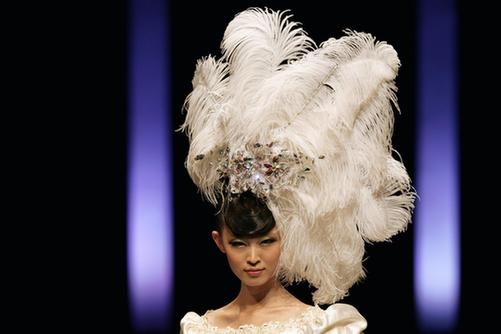
Models present creations from a wedding dress collection by designer Tsai Meiyue at China Fashion Week in Beijing November 3, 2009.[Agencies]


China Fashion Week Ⅰ

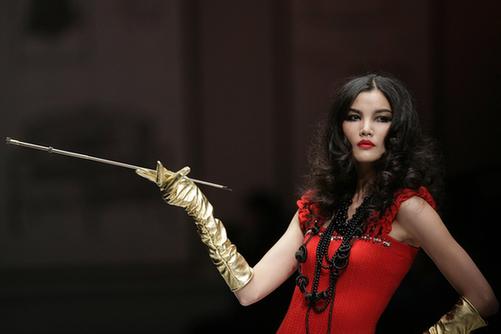
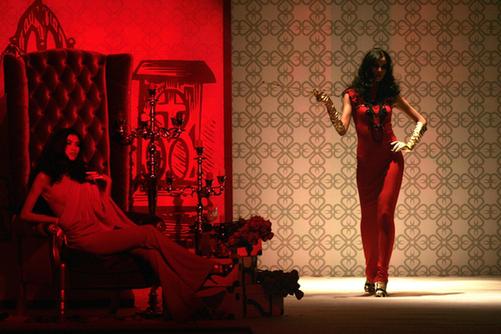
A model presents a creation by designer Qi Gang at China Fashion Week Show in Beijing November 3, 2009.[Agencies]


China Fashion Week Ⅰ

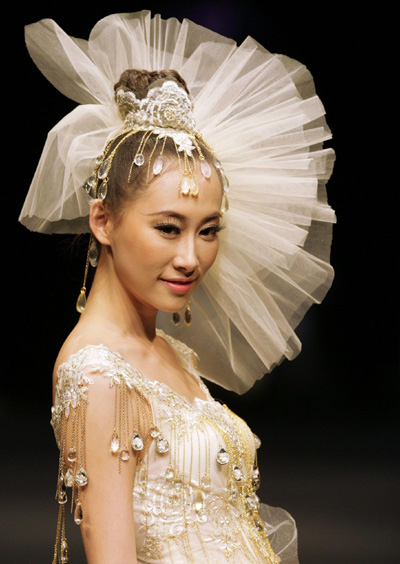
A model presents a creation from a wedding dress collection by designer Tsai Meiyue at China Fashion Week in Beijing November 3, 2009.[Agencies]


China Fashion Week Ⅰ

A model presents a creation from a wedding dress collection by designer Tsai Meiyue at China Fashion Week in Beijing November 3, 2009.[Agencies]


China Fashion Week Ⅰ

A model presents a creation from a wedding dress collection by designer Tsai Meiyue at China Fashion Week in Beijing November 3, 2009.[Agencies]


China Fashion Week Ⅰ

Models present creations by designer Qi Gang at China Fashion Week Show in Beijing November 3, 2009.[Agencies]


China Fashion Week Ⅰ

Models present creations by designer Qi Gang at China Fashion Week Show in Beijing November 3, 2009.[Agencies]


taken from : China Daily


Read more!